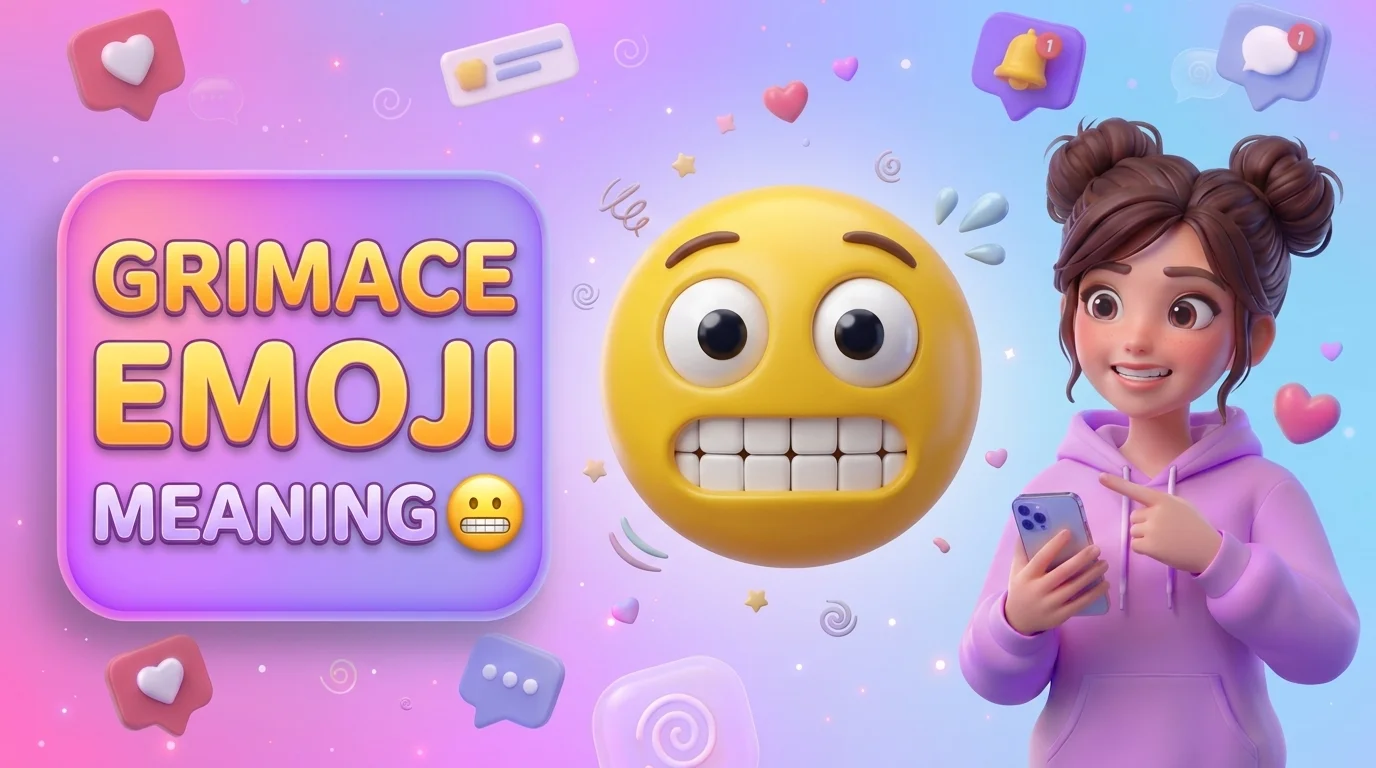
Have you ever received the 😬 emoji in a text message and wondered what the sender is trying to express? The Grimace Emoji Meaning 😬 is often associated with awkwardness, nervousness, embarrassment, or discomfort. People commonly use this emoji when something goes wrong, a conversation becomes uncomfortable, or they are unsure how to react to an unexpected situation.
It can also express tension, regret, or the feeling of making a small mistake. In friendly chats, the grimace emoji may be used humorously to acknowledge an awkward moment or show nervous laughter. Sometimes, it can suggest that someone is uncomfortable with a joke or worried about how their message might be received.
However, its exact meaning depends on the conversation and the relationship between the people involved. In this guide, you’ll learn what the grimace emoji means in texting, WhatsApp, friendship, flirting, and social media, along with practical examples to help you understand when and how to use it.
What Is the Grimace Emoji 😬?
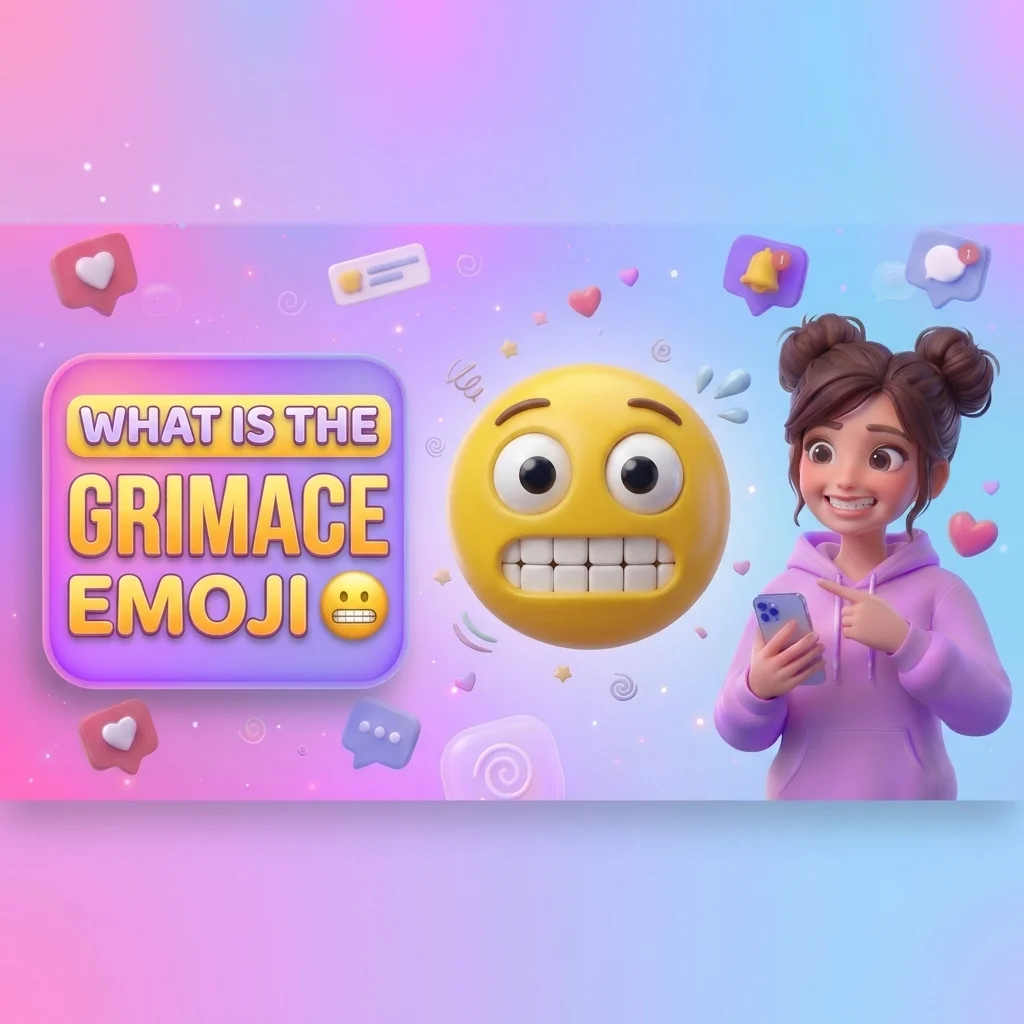
The grimacing face emoji 😬 shows a face with a tense expression and visible clenched teeth. Its appearance gives it a naturally uncomfortable or awkward feeling.
Unlike a normal smiling emoji, 😬 does not usually communicate relaxed happiness. Instead, it often suggests that someone is trying to deal with an uncomfortable moment.
The emoji can communicate feelings such as:
- Awkwardness
- Nervousness
- Embarrassment
- Discomfort
- Tension
- Uneasiness
- Nervous laughter
- Mild fear
- Uncertainty
- A forced or uncomfortable smile
Sometimes the person sending 😬 is not seriously upset. They may simply be acknowledging that something is weird, embarrassing, or difficult.
For that reason, the exact grimace emoji meaning should always be understood from the surrounding conversation.
Grimace Emoji Meaning in Text Messages
In texting, 😬 commonly means “That is awkward,” “Oops,” “I’m nervous,” or “This is uncomfortable.”
It is particularly useful because texting does not provide facial expressions or voice tone. Adding 😬 can tell the other person that the message should not be interpreted as completely serious, confident, or relaxed.
For example:
Person A: “I just realized I was talking about my boss while he was standing behind me.”
Person B: “Oh no 😬”
Here, 😬 communicates sympathy mixed with secondhand embarrassment.
Another example:
“I have my driving test tomorrow 😬.”
The emoji suggests nervousness about the upcoming event.
It can also be used after making a mistake:
“I accidentally deleted the whole presentation 😬.”
In this situation, the emoji makes the message feel like an awkward admission rather than a completely emotionless statement.
Common meanings of 😬 in texting
| Situation | Possible meaning |
| Making a mistake | “Oops” or embarrassment |
| Bad news | Discomfort or nervousness |
| Awkward conversation | “This is awkward” |
| Difficult task | Anxiety or uncertainty |
| Embarrassing story | Secondhand embarrassment |
| Uncertain situation | Nervousness |
| Joke | Playful awkwardness |
| Unexpected event | Shock mixed with discomfort |
Remember that these are possible interpretations, not fixed rules.
Grimace Emoji Meaning on Social Media
On social media, 😬 is often used in comments, captions, replies, and reactions to show an uncomfortable or awkward reaction.
Someone might post:
“When you wave back at someone who wasn’t waving at you 😬”
The emoji reinforces the embarrassing situation.
It can also appear under videos or posts where something goes wrong:
“That landing 😬”
Here, the emoji may communicate discomfort or concern.
On platforms where people communicate through short comments, 😬 can replace a longer response such as:
- “That was awkward.”
- “Oh, that’s uncomfortable.”
- “I don’t know what to say.”
- “That could have gone better.”
- “I’m cringing.”
However, the emoji does not automatically mean something negative. A person may use it humorously when reacting to a harmless mistake.
Grimace Emoji Meaning in Friendship
Among friends, 😬 is often casual and playful.
Close friends may use it after teasing one another, admitting something embarrassing, or sharing an awkward story.
For example:
Friend: “I told everyone I knew how to cook, then burned the toast.”
You: “Bro 😬”
The emoji here is not necessarily expressing serious concern. It can mean something like, “That is painfully funny.”
Friends may also use 😬 when they know something is awkward but do not want to make the situation more serious.
Example
Friend: “I think I accidentally liked a picture from 2018.”
You: “That’s rough 😬”
The emoji adds a humorous reaction to the situation.
Because friends usually understand each other’s communication style, 😬 can become part of their shared humor.
Grimace Emoji Meaning in Romantic Relationships
In a romantic relationship, 😬 can have several meanings depending on what is being discussed.
A partner might use it when they feel nervous about something, admit a mistake, or encounter an awkward situation.
For example:
“I forgot our anniversary date was next week 😬.”
Here, the emoji can show embarrassment or discomfort.
Another example:
“You want me to meet your whole family tonight? 😬”
In this case, 😬 may communicate nervousness about the situation rather than dislike of the family.
Sometimes partners also use the emoji playfully when teasing each other.
“You really think that outfit looks good? 😬😂”
Here, the combination with 😂 changes the tone and makes the message more humorous.
Does 😬 mean something negative in a relationship?
Not necessarily.
The emoji can indicate discomfort, but discomfort does not automatically mean anger, rejection, or relationship problems. You need to consider the actual words, previous messages, and usual communication style of the person.
If someone says:
“I’m nervous about meeting your parents 😬”
that is very different from:
“I don’t want to talk about this anymore 😬.”
The first may indicate nervousness, while the second could indicate discomfort with the conversation.
Grimace Emoji Meaning From a Girl
If a girl sends 😬, the emoji could mean several things, and there is no universal interpretation based only on gender.
She might use it to express:
- Nervousness
- Awkwardness
- Embarrassment
- Uncertainty
- A funny uncomfortable situation
- A mistake
- Nervous excitement
- Mild discomfort
For example:
You: “So, did you tell your parents about us?”
Her: “Not yet 😬”
The emoji could suggest that she feels nervous or uncomfortable about having that conversation.
Another example:
You: “I’m going to sing karaoke tonight.”
Her: “Please don’t 😬😂”
In this case, the emoji is probably playful.
The surrounding words are much more important than trying to decode the emoji based on gender.
Grimace Emoji Meaning From a Guy
A guy may use 😬 to communicate nervousness, awkwardness, embarrassment, or uncertainty.
For example:
“I accidentally replied ‘love you’ in the group chat 😬.”
Here, the emoji clearly supports an embarrassed reaction.
Another example:
“I have to ask her out tomorrow 😬.”
This can show nervousness about the situation.
Guys may also use 😬 as a casual reaction to something uncomfortable without wanting to write a long explanation.
Again, there is no special male-only meaning. The same emoji can have different interpretations depending on the person.
Grimace Emoji Meaning From a Crush
If your crush sends 😬, it is easy to wonder whether the emoji has a hidden romantic meaning.
Usually, the emoji itself does not prove romantic interest. It mainly communicates an emotional reaction to the situation being discussed.
For example:
You: “I think I’m going to ask you out.”
Your crush: “Umm 😬”
That response could indicate nervousness, surprise, uncertainty, or discomfort. You would need to look at the rest of the conversation to understand the intended tone.
On the other hand:
You: “I’m so nervous about seeing you tomorrow 😬.”
Your crush: “Same 😬”
Here, both people are explicitly talking about nervousness, so the meaning is much clearer.
The best approach is to focus on the complete message instead of treating 😬 as a secret romantic code.
Grimace Emoji Meaning From a Partner
When a partner sends 😬, consider what they were responding to.
If they say:
“I forgot to buy groceries 😬.”
It probably means embarrassment or an awkward admission.
If they say:
“We’re having dinner with your entire extended family tonight 😬.”
It could mean nervousness or mild apprehension.
If they say:
“You actually wore that shirt? 😬”
The emoji could be teasing, but it might also sound critical depending on the relationship and wording.
A single emoji should not be interpreted independently from the message.
Friendly Meaning of the Grimace Emoji
The friendly use of 😬 is often lighthearted.
Friends may send it when:
- Someone tells an embarrassing story
- A plan goes wrong
- Someone makes a funny mistake
- A friend is nervous
- Something becomes awkward
- Someone admits an unusual habit
For example:
“I just called my teacher ‘Mom’ 😬.”
A friend might respond:
“No way 😬😂”
The emoji shows that the situation is awkward but funny.
Romantic Meaning of the Grimace Emoji
The grimace emoji meaning in romance usually depends on the emotional context.
It can indicate nervousness before a date, awkwardness during flirting, embarrassment after a romantic confession, or uncertainty about a romantic situation.
For example:
“I bought flowers for our first date 😬.”
This could express nervous excitement.
Another example:
“I told her I like her 😬.”
Here, 😬 can show nervousness after revealing romantic feelings.
However, 😬 by itself should not be treated as a flirting emoji. Unlike ❤️, 😍, 😘, or 🥰, it does not normally communicate affection directly.
Emotional Meaning of 😬
Emotionally, 😬 is often associated with tension.
It can show that someone is experiencing a moment where they do not feel completely comfortable.
The emotion might be:
Nervousness:
“I have an interview tomorrow 😬.”
Embarrassment:
“I sent the message to the wrong person 😬.”
Awkwardness:
“That conversation got weird 😬.”
Uncertainty:
“I don’t know if this is going to work 😬.”
Nervous humor:
“Well, that didn’t go according to plan 😬😂.”
The emoji works well because it can express a mixture of emotions instead of only one.
Playful Meaning of the Grimace Emoji
Sometimes 😬 is intentionally exaggerated for humor.
Someone might say:
“I ate the entire cake by myself 😬.”
They may not actually feel distressed. They are using the emoji to make their confession funny.
Another example:
“I told my friend I’d only watch one episode. It’s 4 a.m. 😬.”
The emoji adds a playful sense of guilt.
This type of use is especially common between people who already understand each other’s humor.
Sarcastic or Humorous Meaning of 😬
The grimacing face can also be sarcastic.
For example:
“Great, another three-hour meeting 😬.”
The sender may not literally be smiling. They may be humorously acknowledging that the situation is unpleasant.
Another example:
“I absolutely love waking up at 5 a.m. 😬.”
Depending on the context, the emoji can make the sarcasm obvious.
The emoji can therefore soften or signal an ironic statement.
Positive and Negative Interpretations
The same 😬 emoji can sometimes carry either a relatively harmless or a more negative tone.
| Interpretation | Example | Likely feeling |
| Nervous | “My exam starts in 10 minutes 😬” | Anxiety |
| Embarrassed | “I called him by the wrong name 😬” | Embarrassment |
| Playful | “I ate your fries 😬” | Mischief |
| Awkward | “Well… that was unexpected 😬” | Uneasiness |
| Sarcastic | “Another Monday morning 😬” | Humor |
| Uncertain | “I hope this works 😬” | Doubt |
| Concerned | “That doesn’t look safe 😬” | Discomfort |
This is why emoji interpretation should always consider context.
Common Situations Where People Use 😬
People frequently use the grimace emoji when something does not go exactly as planned.
1. After Making a Mistake
“I sent the email without the attachment 😬.”
Meaning: “Oops, I made a mistake.”
2. Before Something Nerve-Racking
“My interview starts in five minutes 😬.”
Meaning: “I’m nervous.”
3. During an Awkward Conversation
“So… we need to talk about yesterday 😬.”
Meaning: “This may be uncomfortable.”
4. After an Embarrassing Moment
“I waved at someone who wasn’t waving at me 😬.”
Meaning: “That was embarrassing.”
5. When Something Goes Wrong
“The Wi-Fi stopped working during my presentation 😬.”
Meaning: “This situation is bad or awkward.”
6. As a Joke
“I finished the entire pizza myself 😬.”
Meaning: “I know I probably shouldn’t have done that, but it’s funny.”
Grimace Emoji vs. Similar Emojis
Several emojis can look emotionally similar to 😬, but their common uses differ.
😬 vs. 😅
The 😅 smiling face with sweat often communicates relief, nervous laughter, embarrassment, or “that was close.”
The 😬 grimacing face tends to emphasize tension, awkwardness, discomfort, or an uneasy reaction.
Compare:
“I almost missed my flight 😅.”
This can suggest relief.
“I missed my flight 😬.”
This sounds more uncomfortable or awkward.
😬 vs. 😳
The 😳 flushed face is commonly associated with embarrassment, surprise, shock, or feeling exposed.
The 😬 emoji usually feels more tense or awkward.
Example:
“Everyone heard me sing 😳.”
This emphasizes embarrassment.
“I forgot the lyrics halfway through 😬.”
This emphasizes the uncomfortable situation.
😬 vs. 😓
The 😓 downcast face with sweat can express stress, disappointment, exhaustion, or worry.
The 😬 emoji is more often associated with awkwardness or a tense reaction.
😬 vs. 😂
The laughing emoji 😂 strongly communicates amusement.
The grimace emoji does not necessarily mean something is funny. It can mean that something is awkward or uncomfortable.
People sometimes combine them:
“I can’t believe you actually did that 😬😂.”
Together, the emojis suggest something was awkward but also funny.
😬 vs. 😐
The neutral face 😐 is more emotionally flat.
The grimacing face 😬 shows visible tension or discomfort.
For example:
“Okay 😐”
may sound neutral or unimpressed.
“Okay 😬”
can sound more like “Uh… okay, this is awkward.”
Can 😬 Mean “I Don’t Like It”?
Yes, but not always.
Someone might use 😬 to show that they dislike or feel uncomfortable about something.
For example:
“How was the movie?”
“Honestly, it was pretty bad 😬.”
However, the emoji alone does not necessarily mean “I hate this.”
It can simply show uncertainty or awkwardness.
Can 😬 Mean Nervousness?
Yes. Nervousness is one of the most common interpretations.
For example:
“I’m meeting my girlfriend’s parents tonight 😬.”
The emoji communicates that the person feels nervous about the event.
It can also be used before exams, interviews, presentations, dates, difficult conversations, or important decisions.
Can 😬 Mean Embarrassment?
Yes.
The emoji is often used after an embarrassing moment.
For example:
“I called the customer by the wrong name 😬.”
Here, the sender is likely acknowledging their embarrassment.
It can also communicate secondhand embarrassment:
“He proposed on the giant screen and she said no 😬.”
In this context, the sender is reacting to an uncomfortable situation involving someone else.
Can 😬 Be Flirty?
It can appear in a flirtatious conversation, but it is not inherently a flirty emoji.
For example:
“I might have to steal you for dinner sometime 😬.”
Here, 😬 could make the flirting feel shy or nervous.
But the romantic meaning comes primarily from the words, not from the emoji itself.
If someone sends 😬 during flirting, look at the entire conversation before deciding what they intended.
How to Respond When Someone Sends 😬
Your response should match the situation.
There is no single correct response to the grimace emoji because the sender could be nervous, embarrassed, joking, or uncomfortable.
If a Friend Sends 😬
You can respond casually:
- “What happened? 😂”
- “Oh no, tell me everything.”
- “That sounds awkward!”
- “You’re in trouble 😂.”
- “I knew something went wrong.”
If Your Crush Sends 😬
Keep your response relaxed rather than immediately assuming romantic interest.
You could say:
- “Haha, why the nervous face?”
- “Everything okay?”
- “You look nervous 😄.”
- “Should I be worried?”
- “What happened?”
These responses give the other person an opportunity to explain.
If Your Partner Sends 😬
If the message sounds serious, ask what is wrong.
For example:
“You okay? What happened?”
If the situation is clearly playful, you can respond humorously:
“That face tells me everything 😂.”
If Someone Sends 😬 After Making a Mistake
A supportive response might be:
“Don’t worry, it happens.”
Or:
“You’re good. No big deal.”
If the mistake is funny:
“Okay, that’s actually hilarious 😂.”
If You Don’t Understand Why They Used 😬
The simplest solution is to ask.
“What does the 😬 mean here? 😂”
That may sound more natural than guessing incorrectly.
How Context Changes the Grimace Emoji Meaning
Emoji interpretation depends on several factors.
The Words Around the Emoji
“I have an exam tomorrow 😬” clearly suggests nervousness.
“I ate your last cookie 😬” is more likely playful.
Your Relationship
A close friend may use 😬 jokingly, while someone you barely know may use it to express genuine discomfort.
The Conversation Topic
A serious conversation can make 😬 seem concerned or uncomfortable. A funny conversation can make the same emoji feel playful.
Other Emojis
Combinations can change the tone.
😬😂 often suggests awkwardness mixed with humor.
😬❤️ may suggest nervous affection in some romantic contexts.
😬😳 can emphasize embarrassment or discomfort.
These combinations still depend on the surrounding message.
Personal Communication Style
Some people use emojis frequently and casually. Others use them very selectively.
A person who sends 😬 after almost every awkward joke may not attach much emotional weight to it.
Common Misunderstandings About 😬
Misunderstanding 1: 😬 Always Means Anger
It usually does not.
The emoji more commonly communicates tension, awkwardness, nervousness, embarrassment, or discomfort.
Misunderstanding 2: 😬 Always Means Rejection
Not necessarily.
If someone sends 😬 after a romantic message, it could mean nervousness, surprise, uncertainty, or discomfort. More context is needed.
Misunderstanding 3: 😬 Is Always Negative
No.
People frequently use it humorously.
For example:
“I ate the last slice 😬.”
That may be playful rather than genuinely negative.
Misunderstanding 4: 😬 Has a Secret Meaning From Girls or Guys
There is no universal gender-specific definition.
People use emojis according to their own communication habits.
Misunderstanding 5: 😬 Automatically Means Someone Is Lying
The emoji itself does not prove dishonesty.
Someone might use it after admitting something embarrassing, but that does not mean the statement is false.
Grimace Emoji Meaning in Different Contexts
Here is a quick reference:
| Context | Possible meaning |
| Texting | Awkwardness or nervousness |
| Friendship | Playful embarrassment |
| Romance | Nervousness or uncertainty |
| Crush | Shyness, surprise, or discomfort |
| Social media | Reaction to an awkward situation |
| Work | Tension or concern |
| School | Nervousness about exams or assignments |
| Jokes | Awkward humor |
| Mistakes | “Oops” |
| Difficult conversation | Uneasiness |
| Bad news | Discomfort |
| Unexpected event | Nervous reaction |
When Should You Avoid Overthinking 😬?
Emoji analysis can become confusing when you try to find a hidden meaning in every symbol.
If someone sends:
“I forgot my homework 😬”
you probably do not need to search for a deeper emotional message. The emoji likely just reinforces the person’s embarrassment.
Likewise, if a friend says:
“I ate way too much 😬”
the emoji may simply be humorous.
Look at the whole conversation instead of treating one emoji as a secret code.
A Simple Way to Understand 😬
When you see 😬, ask yourself three questions:
1. What did the person just say?
The words usually provide the biggest clue.
2. What is our relationship?
A close friend may use the emoji differently from a stranger or partner.
3. Is the conversation serious or playful?
This can completely change the interpretation.
If someone says, “I have bad news 😬,” it probably signals discomfort.
If they say, “I ate all the cookies 😬😂,” it is probably playful.
Final Thoughts on the Grimace Emoji Meaning
The grimace emoji 😬 generally communicates some form of tension, awkwardness, nervousness, embarrassment, or discomfort. It can also be used playfully when someone makes a mistake, encounters an awkward moment, or wants to make a humorous confession.
The most important thing to remember is that grimace emoji meaning depends on context. The same emoji can express nervousness in one message, embarrassment in another, and playful humor somewhere else.
It also does not have a fixed romantic or gender-specific meaning. If a girl, guy, crush, friend, or partner sends 😬, pay attention to their words, the topic being discussed, your relationship, and their normal texting style.
When you are unsure, a simple question such as “Everything okay?” or “Why the nervous face?” can give you a much clearer answer than trying to decode the emoji alone.
In short, 😬 often says something like “This is awkward,” “I’m nervous,” “Oops,” or “I don’t know how to feel about this.” The surrounding conversation tells you which interpretation makes the most sense.
Frequently Asked Questions About Grimace Emoji Meaning
1. What does the grimace emoji 😬 mean?
The grimace emoji 😬 commonly represents awkwardness, nervousness, embarrassment, tension, discomfort, or an uneasy reaction. It can also be used humorously after a mistake or awkward situation.
2. What does 😬 mean in texting?
In texting, 😬 often means “Oops,” “That’s awkward,” “I’m nervous,” or “This is uncomfortable.” The exact meaning depends on the message and conversation.
3. Does 😬 mean someone is embarrassed?
It can. People frequently use 😬 after embarrassing situations or mistakes. However, it can also represent nervousness, uncertainty, or playful awkwardness.
4. What does 😬 mean from a girl?
A girl may use 😬 to show nervousness, embarrassment, awkwardness, uncertainty, or humor. The emoji does not have one special meaning when sent by a girl.
5. What does 😬 mean from a guy?
A guy may use 😬 to communicate nervousness, discomfort, embarrassment, awkward humor, or uncertainty. Its meaning depends on the conversation rather than the sender’s gender.
6. Does 😬 mean flirting?
Not by itself. 😬 is mainly associated with awkwardness, nervousness, or discomfort. It can appear during flirting when someone feels shy or nervous, but the surrounding words provide the romantic context.
7. What does 😬 mean from a crush?
From a crush, 😬 could indicate nervousness, embarrassment, surprise, uncertainty, or an awkward reaction. It should not automatically be interpreted as romantic interest or rejection.
8. What is the difference between 😬 and 😅?
😬 usually emphasizes tension, awkwardness, or discomfort, while 😅 often communicates nervous laughter, embarrassment, or relief after a stressful moment. Their meanings can overlap, so context matters.

Michael Brooks is a content writer and dream interpretation researcher with a passion for exploring the meanings behind dreams and the symbols they contain. He enjoys studying traditional dream interpretations alongside modern psychological perspectives to help readers better understand their dream experiences.